 TP Info
Wagering Requirements Non GamStop Casinos 2026 — Playthrough Guide
Wagering is the mechanic that turns a marketing bonus into a break-even instrument for the operator. This page walks the maths and the fine print behind playthrough at non gamstop casinos.
Wagering, playthrough and rollover defined
Three words for the same idea. “Wagering”, “playthrough” and “rollover” each describe the qualifying stake target that must be placed before a bonus and any winnings from it can be withdrawn as cash. Every promotion at non gamstop casinos contains a wagering multiplier in one of these words, applied either to the bonus amount alone or to the sum of bonus and deposit. The multiplier is not a suggestion; it is a hard rule enforced by the operator’s game engine.
The mechanics: every completed bet on an eligible game moves a counter forward by the stake amount weighted by the game’s contribution percentage. When the counter reaches the qualifying target, the bonus balance converts to cash and becomes withdrawable subject to the maximum-conversion cap. If the balance drops to zero before the counter hits the target, the wagering ends with no conversion. If the promotional window expires with the counter still below target, the bonus and any winnings are voided.
The label used in the terms differs between operators. Curacao-licensed sites tend towards “wagering” and “rollover”; MGA-licensed sites tend towards “wagering” and “playthrough”. Anjouan operators use all three interchangeably. When comparing offers, read for the numeric multiplier rather than the word; the underlying mechanic is identical.
Wagering is the operator’s single most powerful promotional control. Without it, a match bonus would be effectively a cash gift, and the operator could not run promotions economically. With it, the promotional cost is transferred back to the player through the house edge on the required turnover. The multiplier is calibrated by the operator to make the expected value of the promotion slightly positive from the operator’s side after all conditions apply.
Multipliers at non gamstop casinos: x30, x40, x60

Wagering multipliers at offshore operators cluster around three tiers. The friendly tier sits at x25 to x35 and is typical for match bonuses at MGA-licensed sites and for reload offers across the whole market. The standard tier sits at x35 to x45 and covers the majority of first-deposit match promotions at Curacao operators. The aggressive tier runs at x50 to x65 and covers no-deposit offers, staged multi-deposit packages, and any promotion with a headline percentage above 300%.
A friendly-tier bonus on a £100 deposit at 100% match requires roughly £3,000 to £3,500 in qualifying stake. On a 4% house edge (about the middle of the slot range), the expected loss on that turnover is £120 to £140. Given the £100 bonus value, the modelled net position after wagering is slightly negative for the player, and the tail-risk conversion sits at the maximum-conversion cap.
An aggressive-tier bonus on the same £100 deposit at 300% match requires roughly £18,000 to £19,000 in qualifying stake, depending on whether the multiplier applies to bonus or bonus plus deposit. Expected loss on that turnover is £700 to £760. The £300 bonus value is comprehensively overwhelmed by the modelled house-edge cost of the required turnover; the promotion has a clearly negative expected value for the player.
Multipliers do not tell you the whole story. A x30 multiplier on a promotion with a 10-slot excluded list and a £3 maximum-bet cap can be harder to clear than a x40 multiplier with clean contribution and a £5 cap. The multiplier is the headline; the terms in the surrounding paragraphs shape how easy the headline is to achieve in practice.
Bonus-only wagering versus bonus-plus-deposit wagering
This is the single term with the largest impact on real value. A multiplier applied to the bonus alone treats the deposit as untouched cash: you can wager the deposit portion normally and only the bonus counter runs against the qualifying target. A multiplier applied to bonus plus deposit treats the whole balance as promotional: the qualifying target is calculated on the combined amount, effectively doubling the wagering workload for the same headline number.
Numeric example. A x35 wagering on a £100 deposit at 100% match: if the multiplier applies to bonus only, the qualifying target is 35 × £100 = £3,500. If it applies to bonus plus deposit, the target is 35 × £200 = £7,000. Same headline, same match percentage, same multiplier — but twice the stake to clear. The 100% difference sits in a single word in the terms.
Non-UKGC operators split roughly evenly between the two structures. Bonus-only wagering is more common at MGA-licensed sites and at some larger Curacao-licensed brands; bonus-plus-deposit wagering is common at smaller Curacao and Anjouan brands. Two operators marketing similar-looking “100% up to £500 at x35” offers can have quite different real terms because of this single distinction.
How to find the answer in the terms: search the bonus clause for the word “deposit” in a sentence next to “wagering” or “rollover”. If the sentence reads “wagering applies to the bonus amount”, you have bonus-only wagering. If it reads “wagering applies to the deposit and bonus” or “wagering applies to the bonused amount”, you have combined wagering. If the sentence is absent, assume the harsher interpretation.
Weighted contribution: the full schedule
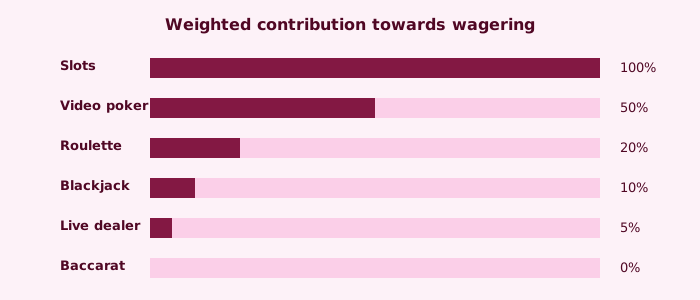
Weighted contribution modulates the effective wagering rate by game category. A £10 stake on a 100%-contributing slot moves the counter by £10. The same £10 stake on a 10%-contributing blackjack table moves the counter by £1. The reason for the schedule is economic: low-house-edge games like blackjack and baccarat would otherwise let a careful player clear wagering with a small expected loss.
| Game category | Typical contribution | Approximate house edge |
|---|---|---|
| Slots (non-jackpot) | 100% | 3% to 6% |
| Video poker | 25% to 50% | 0.5% to 2% |
| Roulette (European) | 10% to 20% | 2.70% |
| Blackjack | 5% to 10% | 0.5% to 1.5% |
| Baccarat | 0% to 5% | 1.06% on Banker |
| Live dealer (all) | 5% or excluded | as base game |
| Progressive jackpots | Excluded | varies |
| Bonus-buy slots | Excluded | elevated by design |
The excluded-slots list is where the schedule interacts with the marketing. Some slots have unusually high published return-to-player figures (Blood Suckers at 98%, Kings of Chicago at 97.8%) or paylines that permit low-variance clearance. These are almost universally excluded from wagering at offshore operators. The exclusion is separate from the general schedule; a slot may sit in the “100% contribution” category and still be excluded by title.
Bonus-buy slot features are the newer addition to exclusion lists. Where a slot lets you pay a multiple of the base stake to enter the bonus round directly, the operator often excludes the bonus-buy stake from wagering while permitting the base game to contribute. This is drafted to prevent bonus-buy variance being used to compress wagering into a small number of large spins.
Maximum-bet caps during active wagering
The maximum-bet cap during wagering is the second most consequential term after the multiplier. Non-UKGC operators cap between £2 and £5 per spin or hand while a bonus is active. The cap is applied at the point of each round; a single stake above the cap voids the bonus and any winnings derived from it, and the operator’s dashboard does not usually warn you in advance.
The cap is machine-enforced from the transaction log. When a promotional balance is active, every completed stake is flagged against the promotion. If any single stake exceeds the cap, a compliance rule voids the bonus and the winnings. The user is notified by an email, usually within an hour but sometimes hours later; the balance already shows the adjusted (deposit-only) figure in the cashier.
The cap catches ordinary users more often than it catches advantage players. Auto-play features that gradually escalate stake, table games where a £5 chip on more than one bet exceeds the cap in aggregate, and side-bets on blackjack are the most common accidental triggers. Live-dealer studios are especially risky because the minimum bet on many live tables exceeds £5, so the cap can be reached on a single hand at a bad table choice.
Practical rule: keep stakes at half the stated cap while wagering. If the terms say £5, keep stakes at £2.50. This gives you headroom against the operator’s log-side rounding and against any accidental slider movement. Disable auto-play features and check the game’s displayed stake before every round.
The expiry clock and how it interacts with wagering
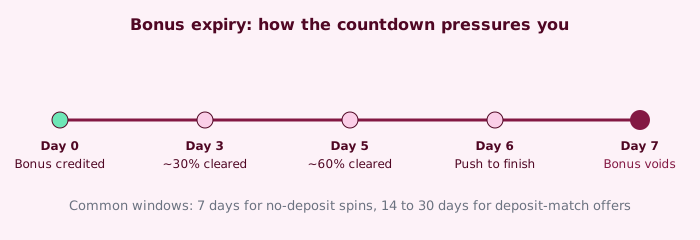
Expiry windows on wagering are usually seven to thirty days. The countdown starts at the moment the bonus is credited, not when you begin playing, and it runs continuously through weekends and overnight. If wagering is incomplete when the window expires, the bonus and any winnings derived from it are voided; the cash deposit (if any) remains untouched at sticky-bonus sites and is returned intact.
The interaction of multiplier, contribution and expiry sets the effective stake pace required to clear wagering. A x40 multiplier on a £200 bonus is £8,000 of qualifying stake. In a seven-day window that is £1,143 per day of turnover. On £3 slot spins at 100% contribution, this is 381 spins per day. On a slot at roughly three seconds per spin, that is about twenty minutes of continuous play per day. On a slot at ten seconds per spin, it is about an hour per day.
The pace becomes uncomfortable as multipliers climb. A x60 multiplier on the same £200 bonus and the same window requires £12,000 of stake, or £1,714 per day, or 571 spins per day at £3 stakes. On the slower live-dealer titles this is not achievable at all during a normal working week; on fast slots it is a two-to-three hour daily commitment.
The pace also becomes riskier as the deadline approaches. The most common trigger of the maximum-bet cap is a stake nudge upwards on the final night to compress the remaining turnover. If you plan to accept a promotion at all, plan the whole wagering session in advance and pace it evenly; a rush push near the deadline is where most cap breaches happen.
Sticky, non-sticky and semi-sticky mechanics
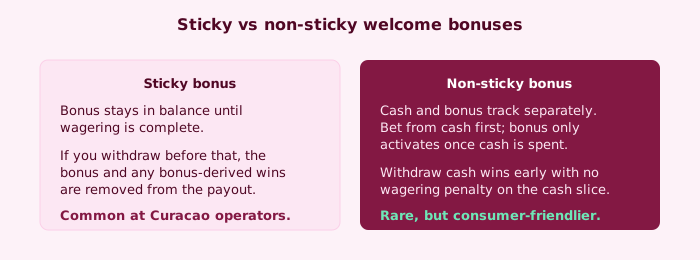
Sticky bonuses attach to the cash balance until wagering completes. A withdrawal request before wagering completes voids the bonus and any winnings derived from it; only the original cash deposit is released. This is the default at Curacao-licensed and Anjouan-licensed operators, and it is the mechanic that lets an operator recover promotional cost on early cash-outs.
Non-sticky bonuses keep cash and bonus in separate wallets. Every bet is drawn from the cash wallet first, and the bonus wallet only activates when cash is exhausted. If you build a positive balance from cash without touching the bonus, you can withdraw the cash winnings and let the bonus be voided. This is the friendlier structure, but it is uncommon in the non-GamStop market outside a few MGA-licensed operators.
Semi-sticky variants sit between the two. On withdrawal request before wagering completes, the bonus is voided but a proportion of the winnings is retained by the player. The formula is usually stated in the terms; it can be a fixed percentage (25% or 50% is common) or a graduated formula linked to wagering progress. Semi-sticky terms are opaque; if you cannot understand the withdrawal treatment from a single paragraph of the terms, treat it as sticky.
Distinguishing between the three structures is worth the reading time. On a sticky bonus, early withdrawal costs you the whole bonus balance. On a non-sticky bonus, early withdrawal costs you nothing beyond the discarded bonus. On a semi-sticky bonus, early withdrawal costs you a formulaic slice. Same headline promotion, three different withdrawal economies.
Withdrawal-conversion caps after wagering
The maximum-conversion cap sits at the end of the wagering process. It sets the ceiling on how much of a bonus-derived balance can be moved to cash once the qualifying stake target is met. Anything above the cap is confiscated by the operator and does not flow into the cashier. The cap is expressed either as a multiple of the bonus (five times is a representative figure) or as a fixed pound figure.
Consider a £100 bonus at x40 wagering with a 5x conversion cap. Suppose you clear the £4,000 qualifying target with £600 remaining in the balance, of which £100 is the deposit and £500 is bonus-derived. The 5x cap allows conversion of up to £500 in bonus-derived winnings, so the whole £500 converts. Your withdrawable balance is £600. If the run had gone better and left you with £1,000 (£100 deposit + £900 bonus-derived), the cap still allows only £500 conversion, and the £400 above it is confiscated.
Fixed-pound caps are more punishing for larger balances. A £100 conversion cap on a no-deposit bonus means the maximum cash-out is £100 regardless of how well the promotional run went. Bonus-round jackpot wins on a promotional spin often finish notionally in the thousands and cap out in the hundreds. The wider marketing narrative around “big wins from small bonuses” is materially misleading because of this cap.
The cap is the operator’s hard-ceiling protection against tail-risk winnings. From an economic perspective it makes promotional cost highly predictable. From a consumer perspective it means the modelled upside of any bonus is much smaller than the theoretical variance of the underlying game would imply. Read the cap before you deposit; it usually shrinks the offer’s real economic value below the marketing figure.
How to read a wagering-conditions clause
Wagering-conditions clauses on offshore promotional pages typically run to 500 to 2,000 words. Use a structured read: five specific facts to extract in order, and a decision rule at the end.
- Wagering multiplier — a numeric figure such as x30, x40 or x60.
- Application scope — whether the multiplier applies to bonus only or to bonus plus deposit.
- Contribution schedule — which games count at what percentage.
- Maximum bet during wagering — the per-round cap, usually between £2 and £5.
- Expiry window — the length of the countdown, and its start point.
Once you have the five facts, do the arithmetic in your head. Multiplier times bonus (or bonus plus deposit) gives the qualifying stake target. Divide by expiry length to get the daily stake pace. Divide by planned per-round stake to get the number of rounds required. Compare against the time available and the game’s typical round length. If the calculation feels borderline, it will be worse in practice because of variance and interruptions.
Decision rule: below a multiplier of x40, above £3 maximum bet, and above a 21-day expiry window, the promotion is at least mathematically clearable by an unhurried session. Above x50, below £3 cap, or below a 14-day window, and the promotion is engineered to burn out most balances before conversion. The middle ground — x40 to x50 with modest constraints — is the majority of the market, and the practical outcome depends heavily on individual variance.
Our sister pages cover the related mechanics. The welcome bonus page looks at match tiers and no-deposit offers, and the free spins page covers the spin-specific variables that sit inside a wagering framework. Between them, you should have enough to read a promotional page without needing to squint at the small print twice.
Frequently Asked Questions
What are wagering requirements at non GamStop casinos?
Wagering requirements are the amount of qualifying stake you must place before a bonus and any winnings from it can be converted to withdrawable cash. Multipliers of x30 to x60 are standard. The requirement is applied at the game-round level, subject to game contribution weighting.
How is playthrough different from rollover?
Playthrough, rollover and turnover are three names for the same concept: the multiplier applied to a bonus to derive the qualifying stake target. Different operators use different words, but the mechanic is identical. Read for a numeric multiplier rather than for the label.
Does the deposit count towards wagering?
At most non-UKGC operators the multiplier applies to the bonus alone. A minority apply it to the sum of bonus and deposit, effectively doubling the qualifying stake target. This is the single most consequential term to identify in any bonus agreement.
Why does live blackjack contribute so little to wagering?
Blackjack has a low theoretical house edge under basic strategy, close to 0.5% on a favourable ruleset. If it counted at 100% towards wagering, careful play would produce a small expected loss and a positive tail-risk balance. Contribution weighting of 5% to 10% adjusts for this.
What is the maximum bet during wagering?
Non-UKGC operators cap bets at between £2 and £5 per spin or hand while a bonus is active. A single bet above the cap voids the bonus and any winnings derived from it. The cap is machine-enforced and applied without warning at the point of stake.
What happens if I withdraw before wagering completes?
Sticky bonuses void the bonus and any bonus-derived winnings on early withdrawal, leaving only your original cash. Non-sticky bonuses let cash winnings withdraw while voiding the bonus balance. Semi-sticky variants retain a proportion under a formula in the terms.
Responsible Gambling
Wagering-requirement mechanics are the operator’s most powerful engagement tool. The multiplier, the expiry, and the maximum-bet cap together create a set of session incentives that pull towards longer, denser gambling sessions than a non-promotional balance would encourage. This pull is exactly what UKGC affordability rules were designed to counter, and it is exactly what a GamStop registration protects a self-excluded user against.
GamStop is a legitimate UK self-exclusion register. If you registered, you did so because the friction between deposit and withdrawal had stopped working for you. Free UK support is available to anyone in that position. GamCare runs a 24/7 helpline on 0808 8020 133. Gordon Moody offers residential treatment for severe gambling harm. The NHS National Gambling Clinic provides specialist assessment for adults and adolescents in England. BeGambleAware funds referral through a national partner network. GAM-Anon supports family and friends. These services are experienced with the exact patterns that lead people to read pages like this one.
Harm-reduction habits: set a hard weekly deposit cap at your bank; keep gambling money in an account separate from bills; put a time-of-day rule around when you play. Background on the UK regulatory framework is available in the Wikipedia entry for the Gambling Act 2005 and in the Act text on legislation.gov.uk.

James Sinclair
Consumer Correspondent at TP Info · Last updated 5 August 2026
James investigates promotional practices in the online gambling market and the fine print of welcome bonuses since 2019, with a focus on wagering requirements that trap unwary players. He writes for TP Info in a plain-English register aimed at UK consumers weighing offshore-licensed gambling platforms.